
Skip to content
AstrBot
Main Navigation HomeBlogRoadmapHTTP API

English

简体中文

English

简体中文

Toggle dark mode

Intro & DeployMessaging PlatformsAI IntegrationUsageDevelopment
Sidebar Navigation

Introduction

What is AstrBot

Community

FAQ

Deployment

Package Manager

One-click Launcher

Docker

Kubernetes

BT Panel

1Panel

Manual

Other Deployments

CasaOS

Compshare GPU

Community-provided Deployment

Support Us

Messaging Platforms

Quick Start

QQ Official Bot

Websockets

Webhook

OneBot v11

WeCom Application

WeCom AI Bot

WeChat Official Account

Personal WeChat

Lark

DingTalk

Telegram

LINE

Slack

Misskey

Discord

Satori

Connect Satori

Using server-satori

Community-provided

Matrix

KOOK

VoceChat

AI Integration

✨ Model Providers

NewAPI

AIHubMix

PPIO Cloud

SiliconFlow

TokenPony

302.AI

Ollama

LMStudio

⚙️ Agent Runners

Built-in Agent Runner

Dify

Coze

Alibaba Bailian

DeerFlow

Usage

WebUI

Plugins

Built-in Commands

Tool Use

Anthropic Skills

SubAgent Orchestration

Proactive Tasks

MCP

Web Search

Knowledge Base

Custom Rules

Agent Runner

Unified Webhook Mode

Auto Context Compression

Agent Sandbox

Development

Plugin Development

🌠 Getting Started

Minimal Example

Listen to Message Events

Send Messages

Plugin Configuration

AI

Storage

HTML to Image

Session Control

Publish Plugin

Platform Adapter Integration

AstrBot HTTP API

AstrBot Configuration File

Others

Self-hosted HTML to Image

Open Source Summer

OSPP 2025

On this page

AstrBot Knowledge Base ​

TIP

Requires AstrBot version >= 4.5.0.
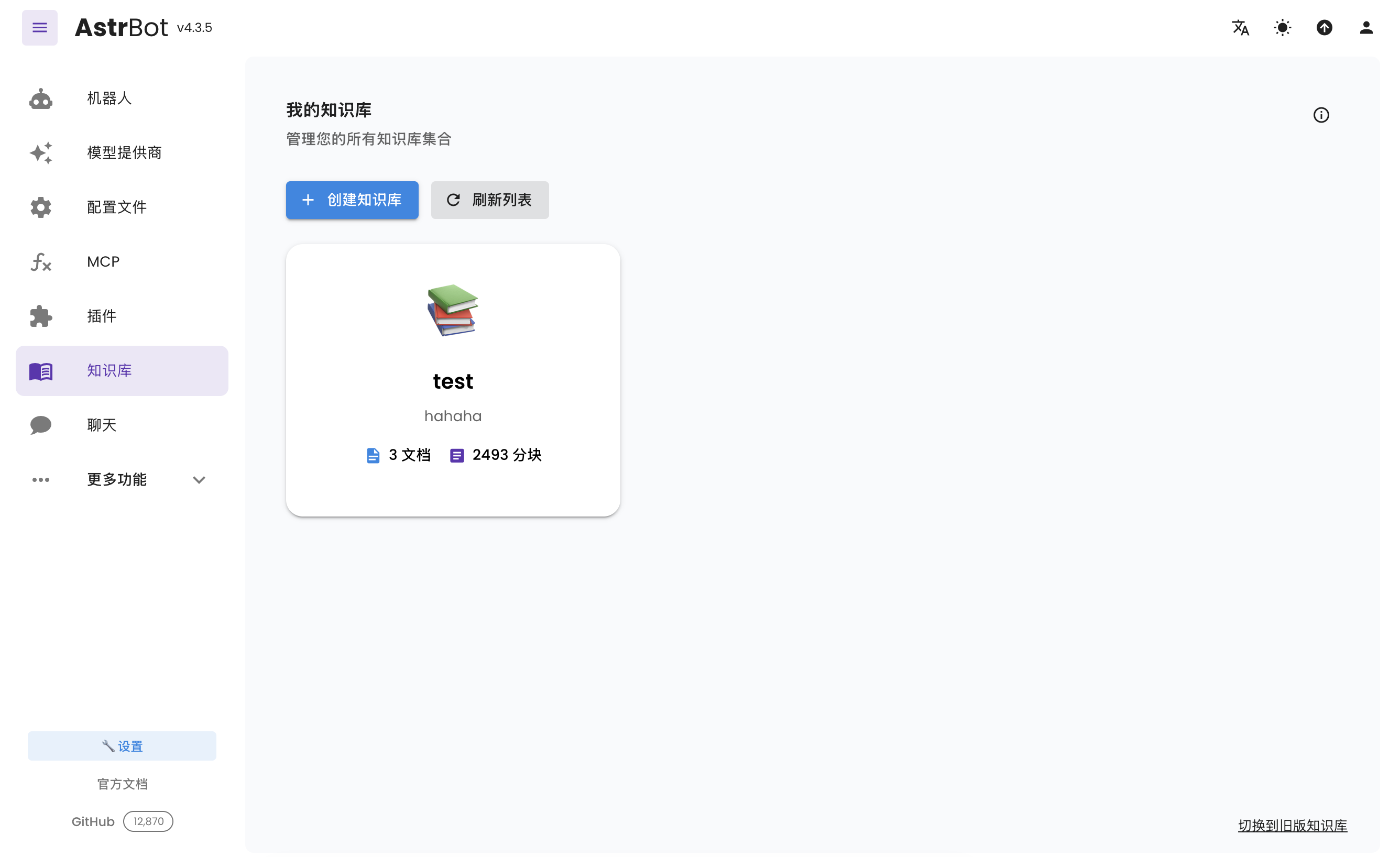
Knowledge Base Preview

Configuring Embedding Model ​

Open the service provider page, click "Add Service Provider", and select Embedding.

Currently, AstrBot supports embedding vector services compatible with OpenAI API and Gemini API.

Click on the provider card above to enter the configuration page and fill in the configuration.

After completing the configuration, click Save.

Configuring Reranker Model (Optional) ​

A reranker model can improve the precision of final retrieval results to some extent.

Similar to configuring the embedding model, open the service provider page, click "Add Service Provider", and select Reranker. For more information about reranker models, please refer to online resources.

Creating a Knowledge Base ​

AstrBot supports multiple knowledge base management. During chat, you can freely specify which knowledge base to use.

Enter the knowledge base page and click "Create Knowledge Base", as shown below:

image

Fill in the relevant information. In the embedding model dropdown menu, you will see the embedding model and reranker model you just created (reranker model is optional).

TIP

Once you've selected an embedding model for a knowledge base, do not modify the model or vector dimension information of that provider, as this will seriously affect the retrieval accuracy of the knowledge base or even cause errors.

Uploading Files ​

After creating a knowledge base, you can upload documents to it. Up to 10 files can be uploaded simultaneously, with a maximum size of 128 MB per file.
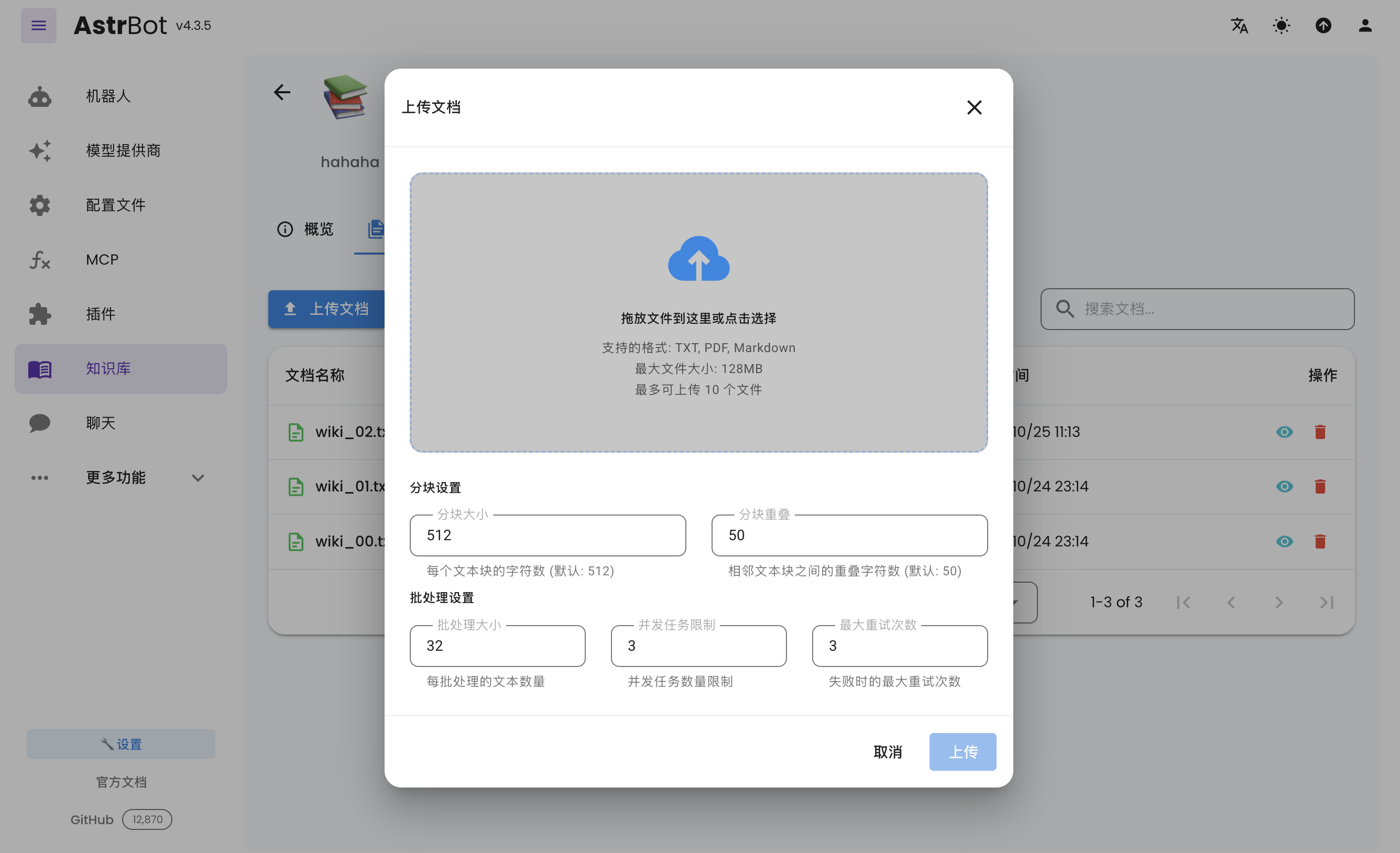
Upload Files

Using the Knowledge Base ​

In the configuration file, you can specify different knowledge bases for different configuration profiles.

Appendix 2: Applying for Free Embedding Models ​

PPIO Cloud ​

  1. Open the PPIO Cloud website and register an account (accounts registered through this link will receive a 15 RMB voucher).
  2. Go to the Model Marketplace and click on Embedding Models.
  3. Click on BAAI:BGE-M3 (as of 2025-06-02, this model is free on this platform).
  4. Find the API integration guide and apply for a Key.
  5. Fill in the AstrBot OpenAI Embedding model provider configuration:
    1. API Key is the PPIO API Key you just applied for
    2. embedding api base: enter https://api.ppinfra.com/v3/openai
    3. model: enter the model you selected, in this example baai/bge-m3.
Edit this page on GitHub

Last updated:

Pager
PreviousWeb Search
NextCustom Rules

Deployed on Rainyun Logo